




Modernizing Pakistan's Agriculture Through Technology: Building a Smarter and More Resilient Future
Introduction
Agriculture has long been the backbone of Pakistan's economy, supporting millions of livelihoods and ensuring food security for a rapidly growing population. Although the sector has shown resilience in recent years, it continues to face mounting challenges, including climate change, water scarcity, declining soil fertility, rising input costs, and fluctuating global commodity prices.
According to the Pakistan Economic Survey 2025-26, agriculture contributes 23.4 percent of the country's Gross Domestic Product (GDP) and employs 33.1 percent of the national workforce. Despite severe monsoon floods in 2025, the sector recorded 2.89 percent growth during FY2025-26, demonstrating its resilience and importance to the national economy.
However, sustaining future growth requires more than traditional farming methods. The next phase of agricultural development must be driven by technology, innovation, and climate-smart practices.
Why Modernization Has Become Essential
Pakistan's farming sector is under increasing pressure from multiple directions. Climate change has made weather patterns unpredictable, resulting in prolonged droughts, flash floods, and heatwaves that directly affect crop yields. Water availability is declining, while population growth continues to increase demand for food.
Traditional farming practices often rely on excessive irrigation, manual labour, and outdated cultivation methods that reduce productivity and waste valuable resources. Modern technology offers practical solutions by enabling farmers to produce more with fewer inputs while reducing environmental impacts.
Precision Agriculture: Farming with Data
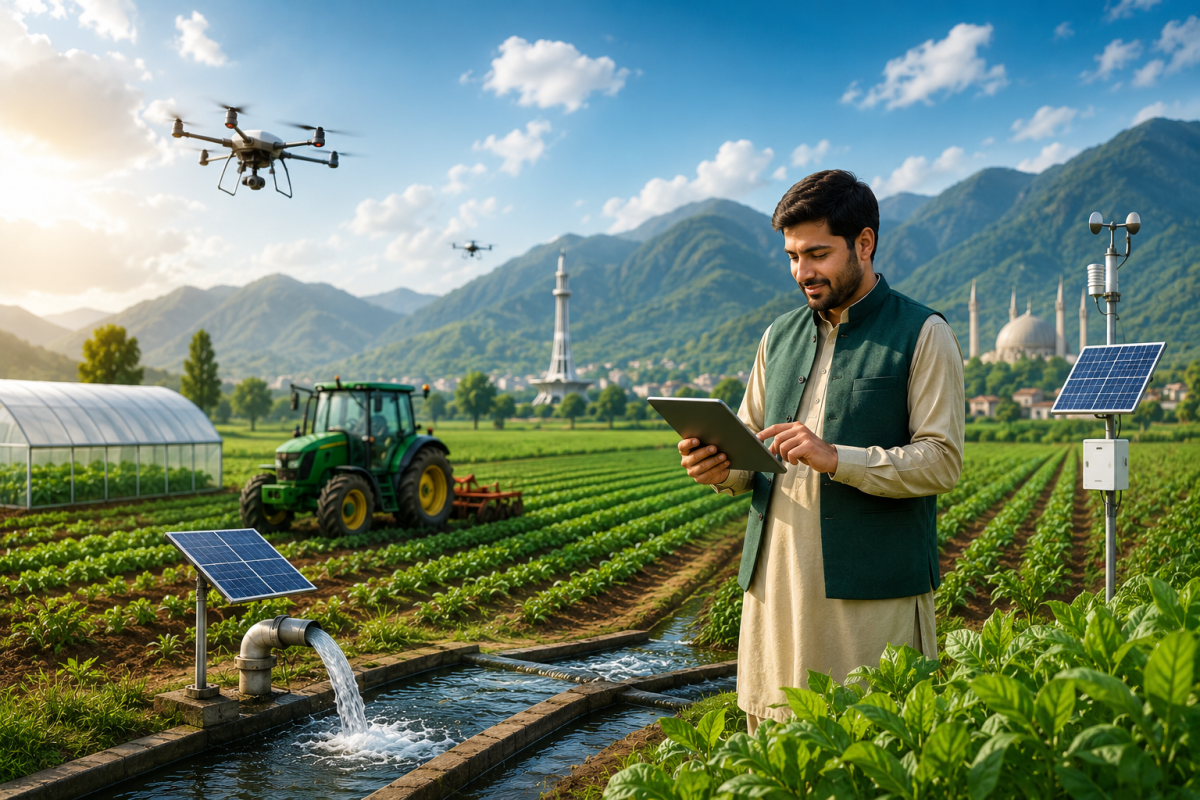
One of the most significant advances in modern agriculture is precision farming, which uses satellite imagery, GPS technology, drones, sensors, and artificial intelligence (AI) to monitor crops and improve decision-making.
Instead of treating an entire field uniformly, precision agriculture allows farmers to identify specific areas requiring irrigation, fertilizers, or pest control. This targeted approach reduces costs, improves yields, and minimizes environmental damage.
Drones equipped with high-resolution cameras can detect crop diseases at an early stage, monitor plant health, and assess water stress long before visible symptoms appear. These technologies enable farmers to respond quickly, reducing production losses.
Smart Irrigation for Water Conservation
Water scarcity remains one of Pakistan's greatest agricultural challenges. Much of the country's irrigation system still depends on flood irrigation, where significant amounts of water are lost through seepage and evaporation.
Modern irrigation technologies including drip irrigation, sprinkler systems, and automated irrigation controlled by soil moisture sensors can dramatically improve water-use efficiency.
Smart irrigation systems supply water only when crops need it, reducing wastage while maintaining healthy plant growth. Combined with laser land levelling, these technologies help maximize every drop of available water.
Artificial Intelligence and Digital Farming
Artificial intelligence is transforming agriculture worldwide, and Pakistan is gradually embracing digital farming solutions.
AI-powered platforms can analyze weather forecasts, soil conditions, historical crop data, and pest trends to provide farmers with recommendations on planting dates, fertilizer application, irrigation schedules, and harvesting times.
Mobile applications now allow farmers to receive weather alerts, market prices, disease diagnostics, and expert advice directly on their smartphones. Such digital tools reduce uncertainty and improve farm management decisions.
Mechanization to Improve Productivity
Farm mechanization remains essential for increasing efficiency and reducing labour shortages. Modern tractors, seed drills, combine harvesters, precision sprayers, and automated planters allow farmers to cultivate larger areas more efficiently while reducing production costs.
Mechanization also minimizes post-harvest losses by improving harvesting speed and grain quality. Expanding access to affordable agricultural machinery through financing schemes and equipment-sharing programs can significantly boost productivity, particularly for small farmers.
Biotechnology and Improved Seed Varieties
Improved seed varieties have played a vital role in increasing agricultural productivity worldwide.
Developing drought-resistant, heat-tolerant, flood-resistant, and disease-resistant crop varieties can help Pakistani farmers adapt to changing climatic conditions. High-quality certified seeds also improve germination rates and increase yields while reducing dependence on pesticides.
Continued investment in agricultural research institutions will be critical to developing crop varieties suited to Pakistan's diverse agro-climatic conditions.
Digital Marketplaces and Financial Inclusion
Technology is also transforming how farmers sell their produce.
Digital marketplaces enable growers to connect directly with buyers, reducing dependence on intermediaries and improving price transparency. E-commerce platforms can help farmers access larger markets while ensuring fairer returns.
Similarly, digital banking and mobile financial services allow farmers to receive payments securely, access agricultural credit, purchase crop insurance, and invest in improved farming technologies.
Climate-Smart Agriculture
Climate-smart agriculture combines productivity with environmental sustainability. Practices such as conservation tillage, crop rotation, integrated pest management, agroforestry, and efficient fertilizer use help protect natural resources while maintaining agricultural output.
Renewable energy technologies, including solar-powered tube wells and irrigation pumps, offer sustainable alternatives to expensive diesel-powered systems. These solutions reduce operating costs while lowering greenhouse gas emissions.
Strengthening Agricultural Research and Extension Services
Technology adoption depends on effective knowledge transfer.
Universities, research institutes, and agricultural extension departments must work closely with farmers to demonstrate modern farming practices and provide practical training. Digital extension services, online advisory platforms, and demonstration farms can help bridge the gap between scientific research and field-level implementation.
Investment in agricultural education and vocational training will also prepare young farmers to use emerging technologies more effectively.
Policy Support and Public-Private Partnerships
Modernizing agriculture requires coordinated action by government, research institutions, financial organizations, and the private sector.
Policies that encourage investment in agricultural technology, improve rural internet connectivity, expand agricultural credit, subsidize modern irrigation systems, and support local manufacturing of farm machinery can accelerate technological adoption.
Public-private partnerships can also help introduce innovative technologies while creating employment opportunities in rural communities.
Challenges to Technology Adoption
Despite its enormous potential, several barriers continue to slow technological transformation in Pakistan's agriculture sector.
These include:
- Limited awareness among farmers about modern technologies.
- High initial investment costs.
- Limited access to affordable financing.
- Poor rural digital connectivity.
- Small landholdings that reduce economies of scale.
- Weak extension services in many regions.
Addressing these challenges will require targeted policies, investment, and farmer education.
The Road Ahead
Pakistan has significant opportunities to transform its agricultural sector through technology. The country's young population, expanding digital infrastructure, growing startup ecosystem, and increasing government focus on food security provide a strong foundation for modernization.
Recent improvements in wheat, rice, and sugarcane production demonstrate the sector's potential when supported by better policies and improved agricultural inputs. However, declining cotton production also highlights the need for technological innovation, research, and crop diversification.
Future success will depend on adopting precision agriculture, expanding mechanization, improving irrigation efficiency, strengthening research, and integrating digital technologies across the entire agricultural value chain.
Conclusion
Agriculture remains central to Pakistan's economic growth, food security, and rural development. While the sector continues to face significant challenges, technology provides an unprecedented opportunity to increase productivity, improve farmers' incomes, and build resilience against climate change.
Modernizing Pakistan's agriculture is not simply about introducing new machines or digital tools it is about creating a smarter, more sustainable farming system capable of feeding a growing population while protecting the country's precious natural resources. By embracing innovation, investing in research, and empowering farmers with modern technologies, Pakistan can transform its agricultural sector into a globally competitive engine of economic growth for decades to come.

Mr. Obaid Ayub is a skilled professional with specialization in Finance and Operations. Demonstrating a proven track record, He possess a unique combination of skills tailored for the dynamic realms of finance, real estate, and marketing. He has successfully optimized business processes and implemented strategic financial initiatives, showcasing his ability to deliver tangible results. His expertise lies in developing and executing robust financial strategies aligned with organizational objectives, ensuring sustainable growth and profitability. He possess significant expertise in budgeting, forecasting, and financial analysis, contributing to the facilitation of well-informed decision-making.
Obaid Ayub
Director Operations House Of Elaan
Prev Article