



Rapid Urbanization in Pakistan and Its Socio-Economic Impact
Introduction
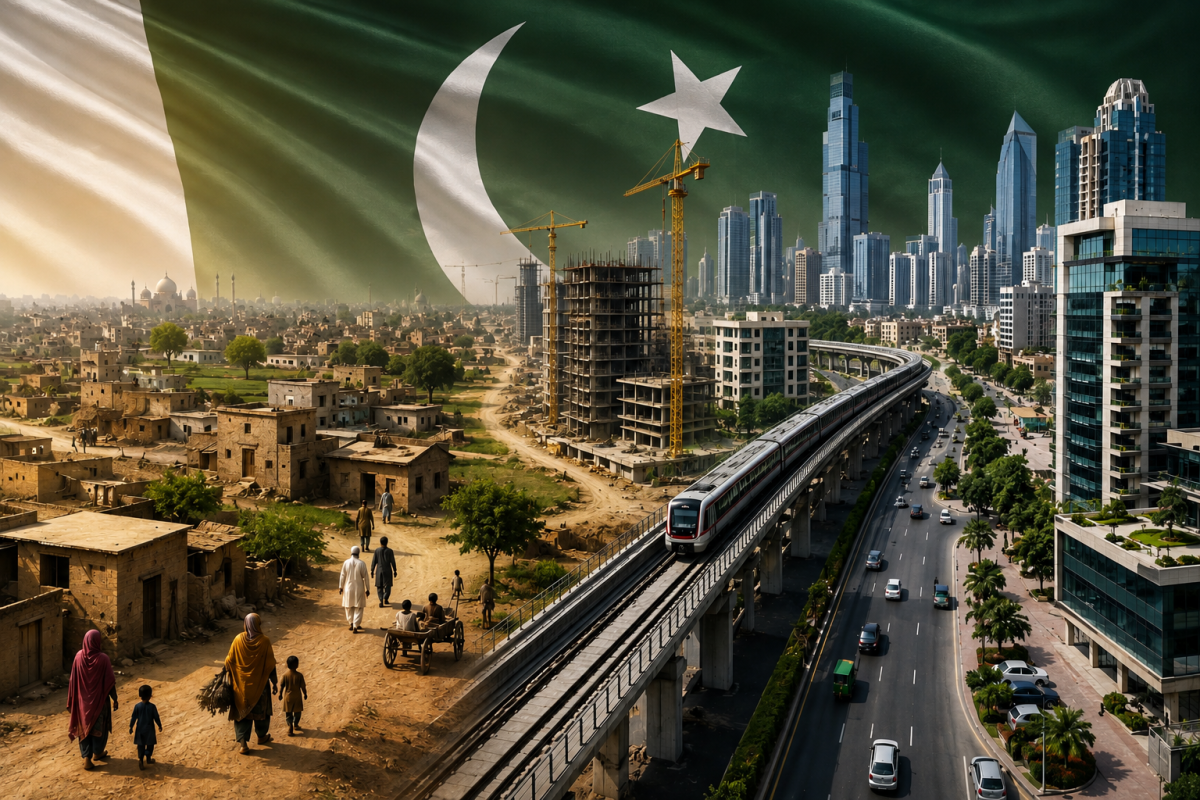
Pakistan is undergoing a profound transformation in the way its population lives and works. For decades, the country was predominantly rural, with agriculture serving as the main source of livelihood for a large proportion of the population. However, rapid population growth, rural-to-urban migration, expanding economic opportunities, and the development of transport and communication networks have accelerated urbanization. Today, Pakistan's cities are expanding at a pace that is often faster than the ability of governments to provide adequate housing, infrastructure, employment, and public services.
The 2023 Population and Housing Census shows that Pakistan's urban population increased from approximately 75.7 million in 2017 to 93.9 million in 2023. The share of people living in urban areas rose from 36.44 percent to 38.88 percent during the same period. Sindh had the highest urban population share at 53.97 percent, followed by Punjab at 40.71 percent.
Urbanization is not inherently a problem. Well-managed cities can generate employment, improve access to education and healthcare, increase productivity, and stimulate innovation. The problem arises when urban growth occurs without effective planning and investment. In Pakistan, rapid and often unplanned urban expansion has created significant socio-economic pressures.
Causes of Rapid Urbanization in Pakistan
One of the major causes of urbanization is rural-to-urban migration. People move to cities in search of better employment, education, healthcare, and living standards. Agricultural uncertainty, limited rural employment opportunities, and disparities between rural and urban incomes further encourage migration.
Another important factor is natural population growth. Pakistan has a large and rapidly growing population, and a significant portion of this growth is increasingly concentrated in urban and peri-urban areas.
The expansion of industrial and commercial activity has also contributed to urban growth. Cities such as Karachi, Lahore, Faisalabad, Rawalpindi-Islamabad, Peshawar, and Multan attract workers because they offer greater concentrations of businesses, factories, markets, universities, hospitals, and government institutions.
Transport infrastructure has additionally encouraged the expansion of cities beyond their traditional boundaries. Residential settlements increasingly develop along major roads and transport corridors, producing sprawling metropolitan regions. The World Bank has described Pakistan's urban growth as being characterized by extensive and often unplanned spatial expansion.
Economic Opportunities Created by Urbanization
Urbanization can be a powerful engine of economic development. Cities bring workers, consumers, businesses, educational institutions, and infrastructure into closer proximity. This concentration can increase productivity and create opportunities for entrepreneurship and employment.
The World Bank has found that between 2002 and 2022, a 1 percentage-point increase in Pakistan's urban population share was associated with approximately a 4 percent annual increase in per-capita income. This illustrates the potential economic benefits of urbanization when cities function efficiently.
Urban areas also provide opportunities outside traditional agriculture. Manufacturing, construction, retail, transportation, information technology, finance, education, healthcare, and other service industries are heavily concentrated in cities. For young Pakistanis, urban centers can therefore provide greater opportunities for professional development and entrepreneurship.
Cities can also encourage innovation. Universities, technology companies, startups, financial institutions, and skilled workers interact more frequently in urban environments, creating conditions for new businesses and ideas to emerge.
Employment and Informal Economy
Despite these opportunities, urbanization has not automatically produced sufficient formal employment. Large numbers of migrants and low-income residents work in Pakistan's informal economy as street vendors, domestic workers, construction workers, drivers, small retailers, and daily-wage laborers.
The informal economy provides essential employment and services, but workers often lack job security, social protection, stable incomes, and access to formal financial systems. Consequently, economic growth in cities can coexist with significant poverty and inequality.
This creates an important contradiction: cities may generate wealth while large sections of their population remain economically vulnerable.
Housing and the Growth of Informal Settlements
One of the most visible consequences of rapid urbanization is the shortage of affordable housing. When population growth exceeds the supply of planned housing, low-income households often settle in informal or poorly serviced communities.
Karachi provides a particularly important example. The World Bank has reported that around half of the city's residents live in informal settlements and that the city's infrastructure has struggled to keep pace with its physical growth.
Poor housing conditions have wider socio-economic consequences. Families living in overcrowded settlements may have limited access to clean water, sanitation, electricity, healthcare, schools, and safe public spaces. Housing insecurity also increases the vulnerability of low-income households to economic and environmental shocks.
Pressure on Infrastructure and Public Services
Rapid urban growth places enormous pressure on infrastructure. Roads become congested, public transport systems struggle to accommodate commuters, and water and sanitation networks face increasing demand. Solid-waste management is another major challenge.
When municipal institutions lack sufficient resources or coordination, the quality of public services declines. The World Bank's recent assessment of Pakistan's secondary cities highlights problems including inadequate water, sanitation, drainage, waste management, and urban planning.
Impact on Education and Healthcare
Urbanization can improve access to education and healthcare because cities generally contain a greater concentration of schools, universities, hospitals, and specialized professionals. Rural migrants may therefore gain access to services that were previously unavailable to them.
However, rapid population growth can also overwhelm existing institutions. Public schools may become overcrowded, while government hospitals can face shortages of beds, medicines, and medical staff. Consequently, simply moving people into cities does not guarantee better human development.
The challenge is to ensure that educational and healthcare infrastructure expands alongside the urban population.
Environmental Consequences
Rapid urbanization has significant environmental consequences. Unplanned construction can reduce green spaces, increase traffic congestion, worsen air pollution, and place additional pressure on water resources.
Pakistan's major cities are also increasingly vulnerable to climate-related hazards. Poor drainage and construction in vulnerable areas can increase the risks associated with urban flooding, while the loss of vegetation and the expansion of built-up areas can contribute to higher temperatures.
The World Bank has identified air pollution, poor waste management, inadequate housing, urban sprawl, and limited access to safe water and sanitation among the major challenges associated with Pakistan's current urban development trajectory.
Thus, urbanization and climate change are increasingly interconnected. Future urban planning must consider not only economic growth but also climate resilience.
Social Inequality and Changing Lifestyles
Urbanization is transforming Pakistani society. Cities bring together people from different regions, languages, occupations, and socio-economic backgrounds. This can encourage cultural exchange and social mobility.
Urban life also changes family structures and lifestyles. Traditional extended-family arrangements may gradually give way to smaller households, while women's participation in education and employment can increase when urban environments provide greater opportunities.
The Central Challenge
Perhaps the most important issue is not urbanization itself but how urbanization is managed.
Many cities suffer from fragmented institutional responsibilities, weak municipal finances, inadequate planning capacity, and insufficient coordination among departments. When urban boundaries expand faster than administrative systems, authorities struggle to provide infrastructure and regulate development.
The World Bank argued the needs of stronger urban institutions, improved municipal financing, better planning, and clearer responsibilities for essential services such as water, sewerage, solid waste, roads, and drainage.
Recent experience also demonstrates that improvements are possible. A World Bank-supported program in 16 intermediate cities of Punjab improved municipal infrastructure and services for more than 4.5 million people by 2025 while helping cities adopt longer-term development plans.
Conclusion
Rapid urbanization is one of the defining socio-economic transformations taking place in Pakistan. It presents both an opportunity and a challenge. On one hand, cities can generate employment, entrepreneurship, productivity, education, innovation, and improved living standards. On the other hand, uncontrolled urban growth can produce unemployment, housing shortages, informal settlements, congestion, pollution, inequality, and pressure on public services.
Pakistan's future will therefore depend not simply on how quickly its cities grow, but on how effectively that growth is managed. The 2023 Census already shows that nearly 39 percent of Pakistan's population lives in urban areas.
The country must recognize this transformation as a central development issue rather than treating it merely as a consequence of population growth.
If Pakistan can strengthen local governments, improve urban planning, invest in affordable housing and public transport, expand municipal services, and make cities more resilient to climate change, urbanization can become an engine of inclusive economic development. If these challenges remain unaddressed, however, the same urban growth that could generate prosperity may instead deepen social and economic inequalities.
The future of Pakistan will increasingly be shaped by its cities. Managing them effectively is therefore not only an urban policy issue it is a national development priority.

Mr. Obaid Ayub is a skilled professional with specialization in Finance and Operations. Demonstrating a proven track record, He possess a unique combination of skills tailored for the dynamic realms of finance, real estate, and marketing. He has successfully optimized business processes and implemented strategic financial initiatives, showcasing his ability to deliver tangible results. His expertise lies in developing and executing robust financial strategies aligned with organizational objectives, ensuring sustainable growth and profitability. He possess significant expertise in budgeting, forecasting, and financial analysis, contributing to the facilitation of well-informed decision-making.