




Technical and Vocational Education: A Solution to Youth Unemployment in Pakistan
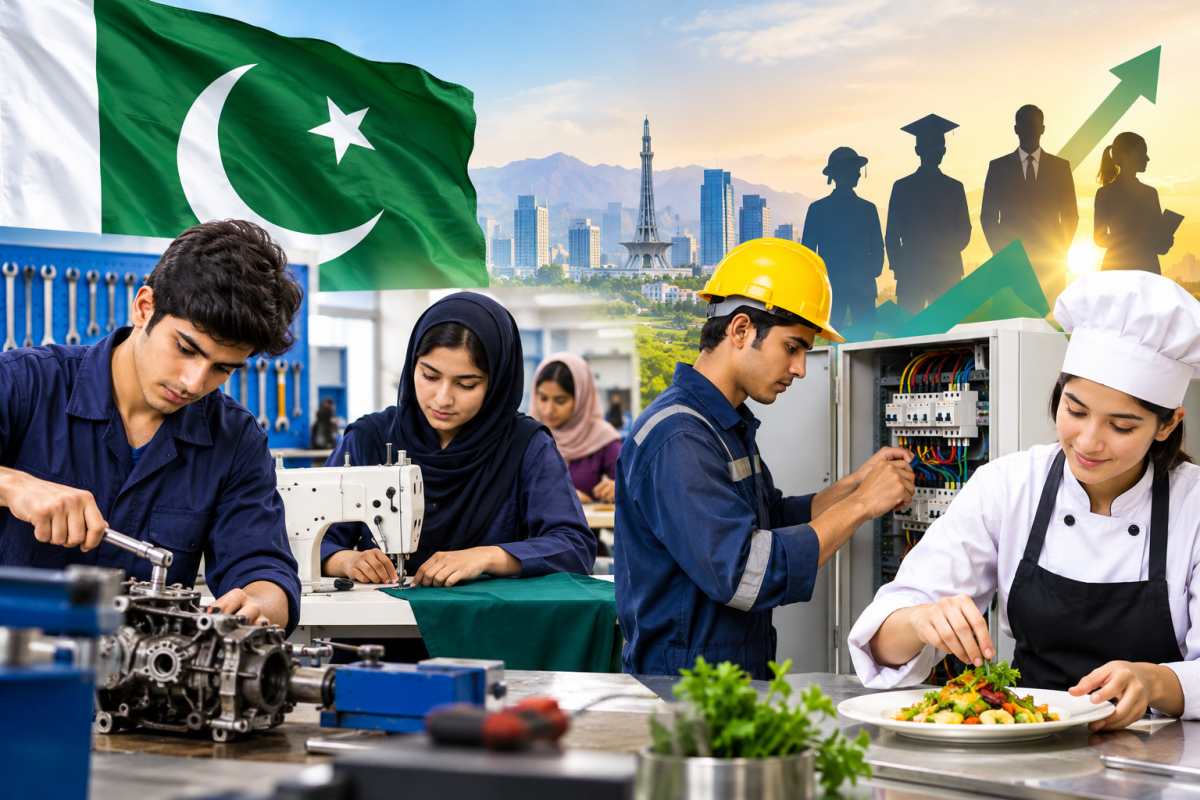
Introduction
Youth are one of the most valuable resources of any country. A young and energetic population can contribute significantly to economic growth, innovation, social development, and national progress. Pakistan has a large and growing youth population, which presents both an opportunity and a challenge. If young people receive quality education, relevant skills, and employment opportunities, they can become a powerful force for economic development. However, if they remain unemployed or lack the skills required by the labor market, youth unemployment can create serious economic and social problems.
One of the major reasons behind youth unemployment in Pakistan is the mismatch between the education system and the requirements of the job market. Many students complete secondary or higher education but do not possess practical skills that employers need. At the same time, industries such as construction, manufacturing, information technology, automobile repair, electrical work, plumbing, hospitality, agriculture, and renewable energy require skilled workers. This situation creates a paradox: employers struggle to find appropriately skilled workers while many educated young people struggle to find jobs.
Technical and Vocational Education and Training (TVET) can help address this problem. Technical and vocational education focuses on practical knowledge and occupational skills that prepare individuals for specific careers. Instead of relying only on traditional academic qualifications, TVET gives young people the opportunity to develop skills that can directly lead to employment, entrepreneurship, and self-employment. For Pakistan, strengthening technical and vocational education can therefore be an important strategy for reducing youth unemployment and supporting sustainable economic development.
Understanding Technical and Vocational Education
Technical and Vocational Education and Training refers to education and training designed to provide practical skills for specific occupations and industries. It includes fields such as electrical work, welding, plumbing, construction, automobile technology, computer technology, graphic design, tailoring, hospitality, agriculture, health-related technical services, and many other professions.
Unlike traditional education, which often emphasizes theoretical knowledge, vocational education combines theory with practical training. Students learn how to perform tasks, operate equipment, solve workplace problems, and apply their knowledge in real-world situations.
For example, a student studying electrical technology can learn about electrical theory but can also gain practical experience in wiring, installing electrical systems, and repairing equipment. Similarly, a student studying automobile technology can learn about vehicle systems while developing practical skills in diagnosing and repairing vehicles.
This practical approach makes vocational education particularly valuable in an economy where employers require workers who can immediately contribute to the workplace.
Youth Unemployment in Pakistan
Youth unemployment is a significant challenge for Pakistan. Every year, large numbers of young people enter the labor market after completing school, college, or university. However, the economy does not always create enough suitable employment opportunities for them. The problem is particularly serious when graduates lack practical or technical skills.
One important issue is the traditional perception that academic education is more prestigious than vocational education. Many families encourage their children to pursue university degrees while considering technical or vocational careers to be less respectable. As a result, some young people spend years obtaining degrees that do not necessarily correspond to available employment opportunities.
Another problem is the skills mismatch. The qualifications young people possess may not match the requirements of employers. A graduate may have theoretical knowledge but lack communication skills, digital skills, technical abilities, or workplace experience. Consequently, employers may have difficulty finding suitable workers even when many young people are looking for jobs.
Youth unemployment can have consequences beyond the loss of income. Long-term unemployment can contribute to frustration, poverty, dependence on families, migration, and social instability. Young people who cannot find productive employment may also lose confidence in their abilities and future prospects.
Therefore, Pakistan needs an education and training system that does not only prepare students for examinations but also prepares them for employment and entrepreneurship.
How Technical and Vocational Education Can Reduce Unemployment
1. Developing Job-Oriented Skills
The most important contribution of vocational education is that it provides job-oriented skills. Training programs can be designed according to the needs of local industries and labor markets. Instead of producing graduates with only theoretical knowledge, institutions can train students for occupations where actual demand exists.
For example, training in solar panel installation, electrical technology, plumbing, construction, computer networking, software development, digital marketing, refrigeration and air-conditioning, and automobile repair can provide young people with practical career opportunities.
When training programs are linked to industry requirements, graduates are more likely to find employment after completing their education.
2. Promoting Self-Employment and Entrepreneurship
Technical education does not necessarily require a person to work for an employer. Many vocational skills can enable individuals to establish their own small businesses.
A trained electrician can start an electrical services business. A skilled mechanic can establish an automobile workshop. A trained beautician can open a salon, while a person with digital skills can provide freelance services to clients locally or internationally.
This makes vocational education particularly important for Pakistan, where the formal job market cannot absorb every new graduate. By developing entrepreneurial skills alongside technical skills, vocational institutions can help young people become job creators rather than only job seekers.
3. Supporting Industry and Economic Growth
A country's industrial development depends heavily on the availability of skilled workers. Manufacturing plants, construction companies, telecommunications firms, energy projects, hotels, transportation businesses, and technology companies all require workers with specialized skills.
Pakistan's economic growth can therefore benefit from a larger pool of skilled workers. When industries have access to qualified technicians and skilled labor, productivity can increase, production costs can decrease, and businesses can expand.
A stronger TVET system can also attract investment because investors are more likely to establish businesses in regions where an appropriately skilled workforce is available.
4. Increasing Opportunities for Women
Technical and vocational education can also improve women's participation in the economy. Women in Pakistan often face social, geographical, and economic barriers to formal employment. Flexible vocational training can provide them with skills that can be used from home or within their communities.
Fields such as tailoring, fashion design, beauty services, handicrafts, digital freelancing, graphic design, e-commerce, food processing, and information technology can provide women with opportunities for income generation.
However, women should not be restricted only to traditionally female occupations. With appropriate facilities and social support, women can also be trained in fields such as information technology, electrical technology, renewable energy, engineering-related trades, and other technical professions.
Greater female participation in the workforce can contribute to household incomes as well as national economic development.
The Role of Digital Skills
The modern labor market is changing rapidly because of digital technology. Traditional vocational training alone may not be sufficient for the jobs of the future. Pakistan therefore needs to combine technical education with digital literacy.
Young people should be trained in areas such as computer applications, programming, cybersecurity, digital marketing, graphic design, e-commerce, data-related skills, and other emerging technologies. Digital skills can also allow Pakistani workers to access international freelance and remote-work markets.
The growth of online work provides an important opportunity for young Pakistanis. A skilled person does not necessarily need to find employment within their local city or even within Pakistan. With appropriate training, they may provide services to international clients through digital platforms.
However, successful participation in the digital economy requires more than access to computers. Young people also need communication skills, English-language proficiency, professional behavior, financial literacy, and knowledge of online business practices.
Challenges Facing Technical and Vocational Education in Pakistan
Despite its potential, vocational education in Pakistan faces several challenges.
First, there is a social perception that vocational education is primarily for students who cannot succeed academically. This perception discourages many capable young people from entering technical fields. Society needs to recognize that skilled workers are essential to economic development and that technical professions can provide respectable and financially rewarding careers.
Second, some training institutions face problems related to outdated equipment and teaching methods. Technology changes quickly, and training centers must regularly update their laboratories, workshops, tools, and curricula.
Third, there can be a weak connection between training institutions and industries. If courses are designed without considering the actual needs of employers, students may graduate with skills that are no longer in demand.
Fourth, many young people, particularly those from low-income families and rural areas, may not have easy access to quality training. Transportation costs, tuition fees, lack of nearby institutions, and limited information about training opportunities can prevent them from benefiting from vocational education.
Finally, the quality of instructors is extremely important. Teachers and trainers must possess both technical knowledge and practical industry experience. Regular professional development is necessary to ensure that instructors remain familiar with modern technologies and workplace practices.
Recommendations for Improving TVET in Pakistan
Pakistan can take several steps to make technical and vocational education more effective.
Strengthen Industry-Education Partnerships
Training institutions should work closely with industries to identify the skills required by employers. Businesses can participate in curriculum development, provide internships, offer apprenticeships, and help assess students' practical skills.
Modernize Training Facilities
Vocational institutes need modern tools, laboratories, machinery, and digital equipment. Training should reflect current technologies rather than outdated workplace practices.
Introduce Apprenticeship Programs
Apprenticeships can bridge the gap between classroom learning and employment. Students should have opportunities to work under experienced professionals and gain practical experience before entering the full-time labor market.
Improve Career Counseling
Students should receive information about different technical careers, income opportunities, training programs, and labor-market trends. Career counseling can help young people make informed decisions instead of choosing careers solely because of social pressure.
Promote Vocational Education Among Youth
Government institutions, schools, media organizations, and communities should promote positive perceptions of skilled professions. Successful technicians, entrepreneurs, freelancers, and skilled workers can serve as role models for young people.
Expand Access in Rural Areas
Vocational training should not be concentrated only in major cities. Mobile training units, community-based training centers, online courses, and regional technical institutes can help young people in rural and underserved areas gain useful skills.
Focus on Emerging Industries
Training programs should prepare students for future industries, including renewable energy, information technology, e-commerce, advanced manufacturing, telecommunications, and other growing sectors. This can help ensure that vocational education remains relevant to changing economic conditions.
Conclusion
Technical and Vocational Education and Training can play an important role in addressing youth unemployment in Pakistan. The country does not simply need more graduates; it needs young people with skills that match the requirements of the modern economy. A strong vocational education system can help bridge the gap between education and employment by providing practical, market-oriented skills.
TVET can create opportunities in both traditional and emerging industries. It can prepare young people for employment, encourage entrepreneurship, support industrial growth, increase women's economic participation, and provide opportunities for individuals who may not follow traditional academic pathways.
However, vocational education should not be viewed as a substitute for academic education. Both systems are necessary. Universities are important for producing professionals, researchers, scientists, teachers, and other highly educated workers, while vocational institutions are essential for producing technicians, craftsmen, operators, and skilled professionals who keep industries and services functioning.
For Pakistan, the real objective should be to build an education system in which academic and vocational pathways are equally respected and connected to the needs of the economy. With modern curricula, qualified instructors, industry partnerships, apprenticeships, digital skills, and greater social acceptance, technical and vocational education can become a powerful tool for reducing youth unemployment.
Pakistan's young population should not be seen merely as a challenge. With the right investment in skills and opportunities, it can become one of the country's greatest economic strengths. Strengthening technical and vocational education is therefore not only an employment strategy but also an investment in Pakistan's long-term economic and social future.

Mr. Obaid Ayub is a skilled professional with specialization in Finance and Operations. Demonstrating a proven track record, He possess a unique combination of skills tailored for the dynamic realms of finance, real estate, and marketing. He has successfully optimized business processes and implemented strategic financial initiatives, showcasing his ability to deliver tangible results. His expertise lies in developing and executing robust financial strategies aligned with organizational objectives, ensuring sustainable growth and profitability. He possess significant expertise in budgeting, forecasting, and financial analysis, contributing to the facilitation of well-informed decision-making.
Obaid Ayub
Director Operations House Of Elaan