



Pakistan Enters the 5G Era: Opportunities, Challenges, and Digital Transformation
Introduction
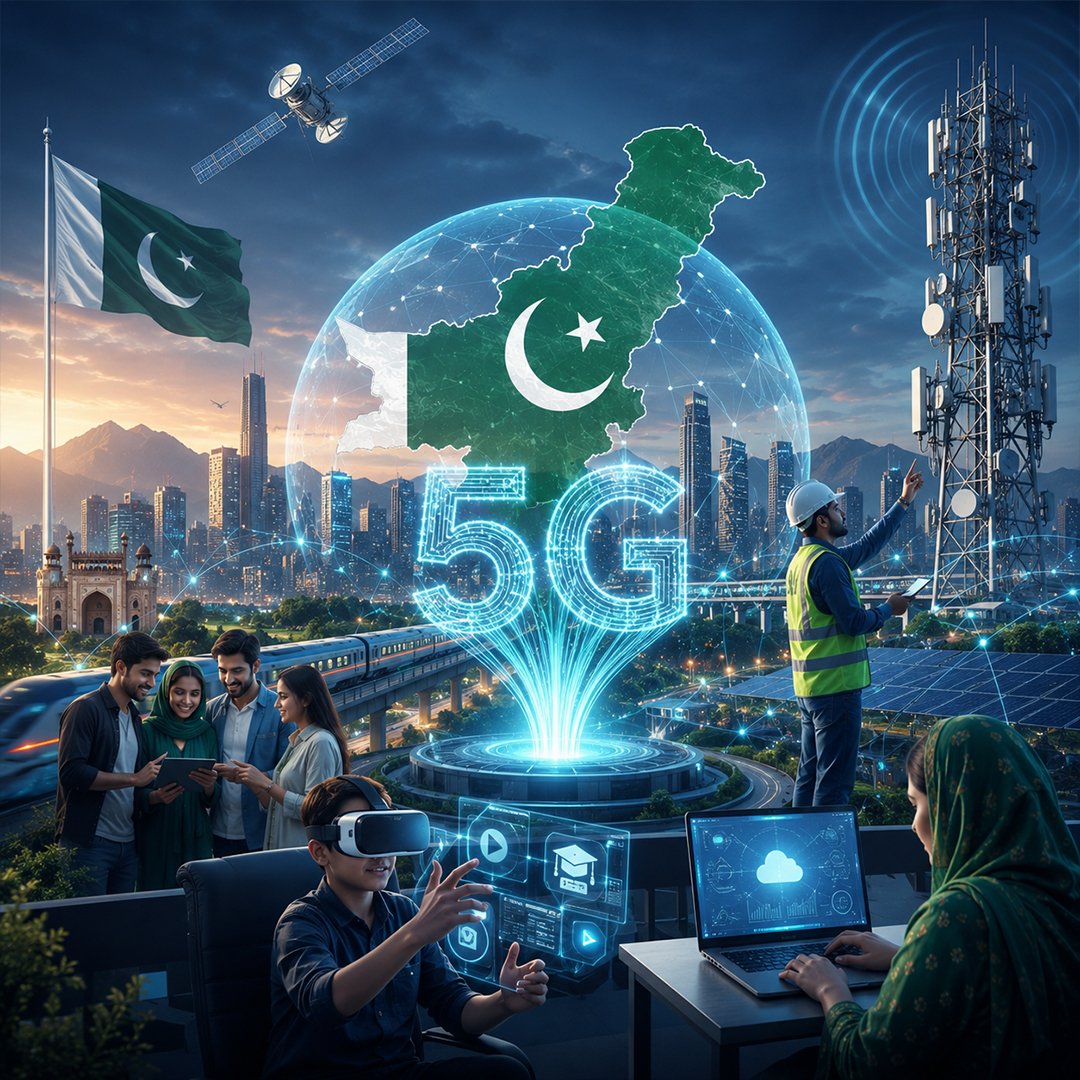
Pakistan entered a new era of digital connectivity in 2026 with the successful launch of its long-awaited 5G spectrum auction. The development marks a major milestone for the country’s telecom sector and is expected to transform industries, businesses, education, healthcare, and public services. With rising internet demand, a growing digital economy, and increasing smartphone penetration, 5G technology is being viewed as a key driver of Pakistan’s future economic growth and technological modernization.
Pakistan’s 5G Spectrum Auction 2026
In March 2026, the Pakistan Telecommunication Authority (PTA) successfully conducted the country’s first 5G spectrum auction. Telecom operators Jazz, Ufone, and Zong secured spectrum licenses after the government raised approximately $507 million through the sale of 480 MHz spectrum across multiple frequency bands. The auction included important spectrum bands such as 700 MHz, 1800 MHz, 2100 MHz, 2300 MHz, 2600 MHz, and 3500 MHz, which will support nationwide 5G deployment in phases.
The PTA announced that the initial rollout of 5G services would begin in selected major cities including Islamabad, Lahore, Karachi, and other urban centers before expanding nationwide. Telecom companies have already started upgrading towers, increasing fiber connectivity, and testing networks to ensure readiness for commercial launch.
Faster Internet Speeds and Better Connectivity
One of the biggest advantages of 5G technology is significantly faster internet speed. While current 4G networks in Pakistan usually provide speeds between 10 Mbps and 40 Mbps, 5G networks can deliver speeds exceeding 1 Gbps under ideal conditions. This means users will be able to download movies within seconds, enjoy ultra-high-definition video streaming, and experience smoother online gaming and video conferencing.
Faster internet will also improve productivity for freelancers, software developers, digital marketers, and IT professionals who rely heavily on stable connectivity. As Pakistan continues to expand its digital workforce, reliable high-speed internet will become increasingly important for economic growth.
Low Latency and Advanced Applications
Another major benefit of 5G is low latency, which refers to the reduced delay in communication between devices. This improvement is extremely important for real-time applications such as online gaming, remote surgeries, autonomous vehicles, smart factories, and financial technology services.
Low latency can help Pakistan modernize critical sectors including healthcare, transportation, banking, and industrial automation. Hospitals in remote areas could use telemedicine and remote diagnostic systems more effectively, while businesses could adopt advanced cloud-based technologies with minimal delay.
Growth of Pakistan’s IT and Freelance Industry
Pakistan’s IT and freelance sector is expected to benefit enormously from 5G connectivity. Pakistan is already among the fastest-growing freelance markets in the world, with thousands of professionals working for international clients. Better internet infrastructure will allow freelancers and software houses to compete more effectively in the global market.
Faster connectivity can also attract foreign investment in Pakistan’s technology sector, data centers, e-commerce industry, and startup ecosystem. Improved digital infrastructure may help increase IT exports and create new employment opportunities for young professionals.
Impact on the Digital Economy
The introduction of 5G will strengthen Pakistan’s digital economy. E-commerce, online banking, fintech applications, ride-hailing services, food delivery platforms, and digital education systems all require high-speed internet infrastructure.
With better connectivity, businesses can expand their online operations, improve customer experiences, and increase digital transactions. The government also expects 5G to support its broader “Digital Pakistan” vision by promoting smart governance, digital payments, and technology-driven public services.
Revolutionizing Education
Education is another sector that can experience major transformation through 5G. During the COVID-19 pandemic, millions of Pakistani students faced difficulties because of poor internet access and unstable online learning systems. High-speed 5G networks can improve virtual classrooms, online examinations, and access to educational resources in rural and underserved areas.
Universities and schools could use augmented reality (AR) and virtual reality (VR) technologies for advanced learning experiences in science, medicine, and engineering.
Industrial and Agricultural Development
Industries and manufacturing units in Pakistan can also benefit from smart automation enabled by 5G technology. Smart factories using Internet of Things (IoT) devices can monitor machinery, reduce production errors, and improve efficiency in real time.
Agriculture, one of Pakistan’s largest sectors, may also use smart farming technologies including automated irrigation systems, drone monitoring, and crop management tools powered by 5G networks. These innovations can increase productivity and reduce operational costs for farmers.
Challenges in Implementing 5G
Despite its advantages, Pakistan still faces several challenges in implementing 5G successfully. The country requires significant investment in fiber-optic infrastructure, tower upgrades, and power supply systems. Many areas still struggle with unstable 4G services, especially in rural regions.
High costs of 5G-compatible smartphones may also slow adoption among low-income users. Furthermore, telecom operators will need to recover billions of rupees spent during the spectrum auction, which could initially increase service costs for consumers.
Another concern is the digital divide between urban and rural areas. Major cities are expected to receive 5G coverage first, while smaller towns and villages may wait several years before experiencing the benefits of the technology.
Future Prospects of 5G in Pakistan
Experts believe that 5G can become a turning point for Pakistan’s economy if implemented effectively. Improved digital infrastructure through 5G could boost economic productivity, attract technology investments, create jobs, and improve Pakistan’s global competitiveness.
The success of 5G will depend on continuous investment, supportive government policies, affordable devices, and expansion of network infrastructure across the country. If these goals are achieved, Pakistan could emerge as a stronger digital economy in South Asia.
Conclusion
The launch of 5G technology in Pakistan in 2026 represents a historic step toward digital transformation. The technology promises faster internet, smarter industries, improved healthcare, better education, and stronger economic growth. Although infrastructure challenges and affordability issues remain, 5G has the potential to revolutionize communication and accelerate Pakistan’s transition into a modern digital economy.
If the government, telecom companies, and private sector continue investing in digital infrastructure, 5G could become one of the most important technological developments in Pakistan’s history.

Ovais Ali Khokhar, as Founder and CEO of House of Elaan & Ovaisco Group, has revolutionized the real estate industry with innovative strategies that blend marketing, investment, legal services, and creativity. His efforts in international relations have led to significant global partnerships. He is deeply invested in youth empowerment, aiming to nurture the next generation of leaders and drive forward a resilient and vibrant future. His work is characterized by a strong commitment to collaboration, innovation, and a vision for a globally connected, sustainable future.